| |
|
|
| |
Bay Area Early Childhood Funders
|
| |
|
|
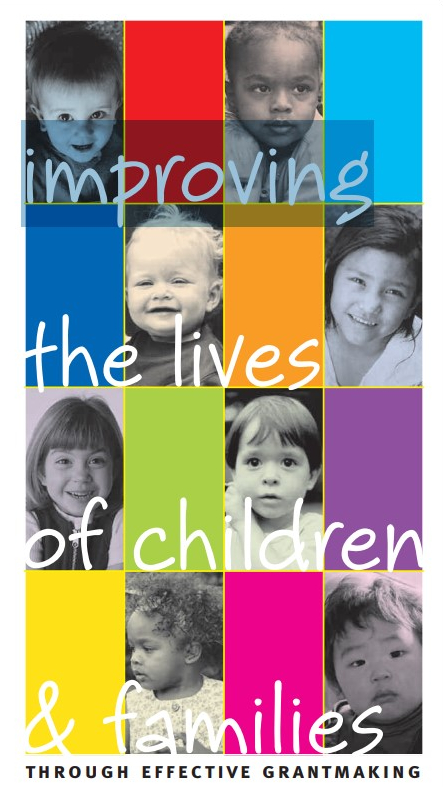
The Early Childhood Funders (ECF) is an
informal affiliation of Bay Area foundations, public funders
and private donors focused on improving grantmaking effectiveness
in the early childhood field. Membership in ECF is voluntary,
members meet three to four times a year to broaden their
knowledge of the early childhood field, share information,
engage in dialogue, and participate in joint funding activities
to improve the lives of young children and their families.
General information about ECF and its
major projects, as well as resources and reports are available
on this website as well as information about the 1997-2002
Quality Child Care Initiative. ECF is a project of Community
Initiatives.
|
|
| |
|
ABOUT ECF
See below for an ECF brochure and membership
list.
|
MAJOR
PROJECTS
|
RESOURCES
See below for a list of reports, articles
and other early childhood resources.
|
|
| |
| |
ABOUT ECF
|
| |
|
| |
|
| |
MAJOR PROJECTS
|
| |
|
|
The Value of Play
for Early Learning
(Ordering Information Below)
The Early Childhood Funders has produced
two publications on the importance of play for early learning.
Copies are available for a minimal postage and handling
charge - see below for ordering information.
The policy brief, Play in the Early
Years: Key to School Success, was
produced to educate policy makers, legislators, school
superintendents, and
early care and education organizations and advocates of
the value of play
for early learning. This research-based brief explains
how play contributes
to school success by helping children develop the skills
necessary for the
development of logic, literacy, self-regulation and social
negotiation,
critical thinking, and leadership. The brief describes
the importance of
play for early learning and emphasizes that play is not
a break from
learning-it is the way young children learn. The brief
also highlights how
the benefits of play increase when children have skilled
teachers who are
well-trained in understanding how play contributes to
learning.
The play pamphlet, Play: It's the way young children
learn, is an easy-to-read less academic version
of the policy brief intended to help parents and teachers
increase their knowledge of the importance of play for
early learning, provide resources for parents and early
care and education teachers to better support the development
of young children, and to educate parents and providers
that play is not a break from learning - it is the way
young children learn. The pamphlet is available in English,
Spanish, Chinese, Vietnamese, Korean and Farsi.
Engaging Business
to Champion Early Care and Education
The Early Childhood Funders formed a partnership
with the Bay Area Council
to engage business to support early childhood education.
Business leaders
are aware that a well-educated high-performing workforce
is critical to
competing in a global economy. Research shows that investments
in
high-quality educational experiences significantly improve
not only school
achievement but also a range of social and emotional outcomes
throughout
life. Economists have shown that public investments in
high-quality early
care and education generate a higher rate of return than
almost any other
public investment.
The Early Childhood Funders worked with
the Bay Area Council to produce the report, Key
to Economic Success in the 21st Century: Investment in
Early Childhood Program, which summarizes much
of the research available on the value of early care and
education. As a result, the Bay Area Council formed an
Early Childhood Education committee which is exploring
ways the business community can champion and dvocate for
public investment in high-quality early care and education.
Click below to download the report:
Messaging/Policy
Project
An ECF Messaging/Policy committee was
established to explore the need for a unified message
among advocates in the early childhood field about the
value and importance of early care and education (ECE),
in order to reach policy makers and the general public.
The committee held a facilitated convening in March 2011
with 12 different ECE advocacy groups to gain their input
on the value of unified messaging/speaking in a unified
voice to promote ECE among policy makers and the general
public. In addition, the committee conducted a review
of ECE literature to identify common themes, and interviewed
23 early childhood leaders representing a variety of points
of view and organizations, to get their input on the themes
identified. The committee is continuing to explore the
role it can play in promoting unity in the ECE field and
exploring what ECF can do to increase support for ECE.
|
|
| |
|
| |
RESOURCES
|
| |
|
Following is a list of early childhood
resources that have been shared with ECF members over
the years. In addition, information is provided about
the 1997-2002 successful joint funding effort the
Quality Child Care Initiative.
|
|
| |
|
| |
QUALITY CHILD CARE INITIATIVE 1997-2002
|
| |
|
In 1997, the ECF created the Quality Child
Care Initiative (QCCI) to promote the need for quality
child care in response to welfare reform. Over five years,
in two separate funding rounds, QCCI raised more than
$4 million and issued over 80 grants aimed at building
a sustainable child care workforce, strengthening advocacy
for child care, creating new and improved child care facilities,
and making child care more accessible to families.
The following documents and reports describe
QCCI activities and lessons learned from the Second
Round of grantmaking. The entire report is available,
as well as an Executive Summary, and the individual chapters
of the report detailing the grantee funding areas. The
report from Round One of funding is also available. They
are hosted by Action Alliance for Children on behalf of
the Early Childhood Funders.
|
|
| |
|
|